Swiftly Workspace vs Toggl Track: an honest comparison
We make Swiftly Workspace, so read this with that in mind.
Toggl Track suits teams who want a polished time tracker on iPhone, iPad, Mac and Apple Watch, free for up to three users. Swiftly Workspace suits service businesses that want approved hours, project budgets, invoices and payments on one customer record, in a native app for iPhone, iPad and Mac.
The difference shows at the end of the month. Toggl Track is built around tracking the hours, and it can turn a report into a PDF invoice. With Swiftly, the hours sit inside a project for a customer, an approver checks them, and the invoice and the payment that follows stay on that customer's record. Which one you need depends on how much happens between logging an hour and getting paid for it.
Swiftly Workspace and Toggl Track at a glance
| Toggl Track | Swiftly Workspace | |
|---|---|---|
| Apple apps | One listing for iPhone, iPad, Mac and Apple Watch | Native Mac app, plus one app for iPhone and iPad; no Apple Watch app |
| Timesheet approval | On the Premium and Enterprise plans | Timesheets are submitted, then reviewed in Timesheet Approvals |
| Invoicing | Can create a PDF invoice from a report | Draft invoices from approved project hours, plus credit notes and proforma invoices |
| Single sign-on | On the Premium and Enterprise plans | Not offered today |
| Pricing model | Per user; free for up to three users | Left out of this comparison |
Checked 2026-10-18 on toggl.com and the App Store: the Toggl Track pricing page and Toggl Track's App Store listing; invoicing checked 2026-10-25 in Toggl Track's help on creating invoices. We leave prices out of this comparison on both sides, and we don't compare plan tiers on our side.
What Toggl Track does well
Toggl Track makes time tracking easy to reach. One App Store listing covers iPhone, iPad, Mac and Apple Watch, and its Mac line carries no Apple silicon requirement, so the same app follows you from desk to wrist. It is priced per user, and free for up to three users, which lets a freelancer or a very small team start without paying.
As a team grows, the paid plans add structure. Its pricing page lists single sign-on and timesheet approvals on the Premium and Enterprise plans, so a company that signs in through an identity provider and checks hours before billing can do both in Toggl. Toggl Track can also create a PDF invoice from a report, so a freelancer can bill straight from the hours they tracked.
Where Swiftly Workspace goes further
Swiftly treats an hour as the start of an invoice, not the end of a report. The hours belong to a project, the project belongs to a customer, and the customer has the invoices and payments.
- Weekly timesheets. Each person logs time on a weekly timesheet against a project and submits it. Our guide to what every time entry should capture covers the habits that make hours reliable, and submitting a timesheet on iPhone or iPad walks the steps.
- Approval before billing. Approvers review submitted weeks in Timesheet Approvals. See how timesheet approval works.
- Projects with structure. Phases, Work Packages and Tasks, with a budgeted amount, so hours land on the part of the job they belong to.
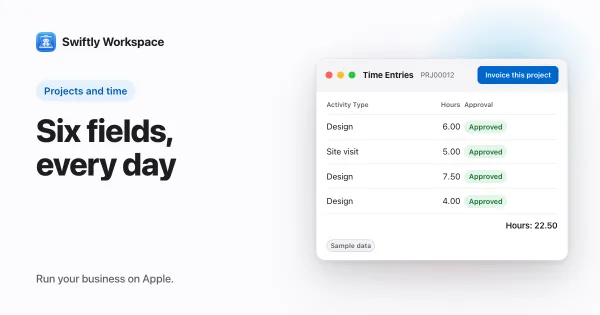
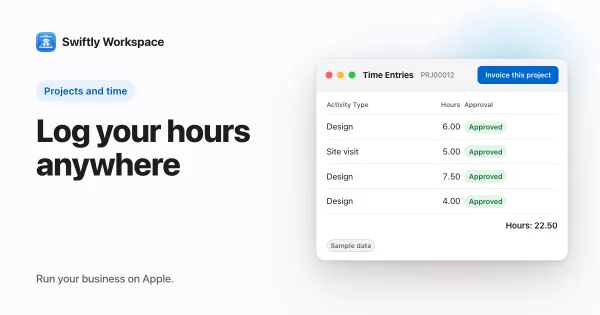
- A draft invoice from approved hours. Invoice this project turns approved billable hours that are not yet invoiced into a draft invoice, which a person checks and finalizes. More in invoicing a project from approved hours.
- The rest of the money side. Customers with contacts and addresses, credit notes and proforma invoices, and customer payments allocated to the open invoice they pay.
- AI on your terms. Your company's own key for a provider such as OpenAI, Gemini or Mistral, or Apple Intelligence on the device, where the text isn't sent to a cloud AI provider.
- Roles with field-level permissions, so each person sees what their role allows.
From logged hour to paid invoice
Following one billable hour through each tool makes the trade clear.
- Logging. In Toggl Track, you track the hour on whichever Apple device is closest, including the Apple Watch. In Swiftly, you add it to your weekly timesheet against a project on iPhone, iPad or Mac.
- Checking. On Toggl's Premium plan and above, a manager can approve timesheets. In Swiftly, the submitted week goes to the project's approvers in Timesheet Approvals.
- Billing. Toggl Track can create a PDF invoice from a report. In Swiftly, Invoice this project gathers approved hours into a draft invoice for the customer, next to the project's budget.
- Getting paid. In Swiftly, the payment is allocated to the invoice it pays, on the same customer record.
If your month ends at step two, Toggl Track is hard to beat. If steps three and four take you an afternoon, Swiftly folds them into the same app.
Choose Toggl Track if
- You want to track time on every Apple device, including the Apple Watch.
- You are a team of three or fewer and want a free plan.
- You already have an invoicing or accounting tool you like.
- Part of your team works outside Apple devices.
Choose Swiftly Workspace if
- Your hours turn into invoices every month, and you want the invoice, the project budget and the payment in the same app.
- A manager approves hours before anyone bills them.
- Projects have phases and a budget, and you want hours to land in the right place.
- You want customers, invoices and payments next to the time, on iPhone, iPad and Mac.
What Swiftly Workspace doesn't do
Swiftly has no Apple Watch app. It has no estimates, it is not accounting software, and it doesn't offer company single sign-on today. It runs on Apple devices, so a team with Windows or Android users will be better served by a cross-platform tracker. And if all you need is to know where the time went, Toggl Track does that with less to set up.
Weighing more options? Our roundup of Toggl Track alternatives for projects and billing lines up several, and our comparison with a time tracker that invoices covers a close neighbor.
What to test in a trial
Use a real week, not a sample project. Log the hours in each tool, have someone else approve them, and then produce the invoice the customer would receive. Write down how long the billing step took and whether you had to copy any number by hand. To try Swiftly with your own records, Swiftly Workspace imports customers and their contacts, vendors, items, open invoices, payments and projects from CSV or XLSX; bring across invoices that are still fully unpaid, and settle partly paid ones in the old tool.
Frequently asked questions
Does Toggl Track work on the Apple Watch?
Yes. On 2026-10-18, Toggl Track's App Store listing covered iPhone, iPad, Mac and Apple Watch. Swiftly Workspace runs on iPhone, iPad and Mac, with no Apple Watch app.
Which Toggl Track plans include timesheet approvals?
Toggl Track's pricing page listed timesheet approvals and single sign-on on the Premium and Enterprise plans when we checked on 2026-10-18. Plans change, so check the page before you decide.
Can Toggl Track create invoices?
Yes. Toggl Track's help pages describe creating a PDF invoice from a report (checked 2026-10-25). Swiftly Workspace makes a draft invoice from a project's approved hours, keeps it on the customer record and records the payment against it.
How does Swiftly Workspace record time?
Each person fills in a weekly timesheet against their projects and submits it. Approvers review it in Timesheet Approvals, and approved billable hours can then go on a draft invoice with Invoice this project.
Run your business on Apple.
Create your account on the web, then set up your workspace in the app on your iPhone, iPad or Mac.